

How Often Should You Bathe Your Dog? A Complete Guide
Most dogs need a bath every 4 to 6 weeks. But that's a starting point, not a rule - the actual number shifts considerably based on your dog's coat, how active they are, and whether they have any skin conditions. Double-coated breeds like Huskies do better with fewer baths (every 6-12 weeks), while curly-coated dogs and long-haired breeds often need bathing every 2-4 weeks to prevent matting. Bathing too often strips natural oils and causes dry, irritated skin. Bathing too rarely leads to odor, matting, and potential infections. The goal is finding the sweet spot for your specific dog - and this guide will help you get there.
Why "how often should I bathe my dog?" doesn't have one answer
Walk into any groomer and ask how often dogs should be bathed. You'll get a range of 10 different answers - not because groomers are guessing, but because the honest answer really does depend on the individual dog.
A Siberian Husky that spends most of its time indoors, rarely rolled in anything questionable, and gets brushed daily? That dog genuinely might only need a bath every three months. A Labradoodle with an active outdoor life, swimming in ponds every weekend? Every two to three weeks, minimum.
The biology matters too. Dogs don't sweat the way humans do - they regulate temperature primarily through panting. Their skin produces natural oils (sebum) that protect against moisture loss and bacterial invasion. Over-bathe, and you strip those oils. Under-bathe, and you let dirt, bacteria, and odor build up. Neither extreme is good.
Veterinarians generally land on a baseline of every 4 to 6 weeks for dogs without specific skin conditions or coat needs. That's a reasonable starting point - and for many dogs, it's exactly right. But the rest of this guide is about understanding where your dog lands relative to that baseline.
The Goldilocks problem: too often vs. too rarely
Before we get into specific recommendations by coat type, it's worth understanding what's actually at stake when you get the frequency wrong - in either direction.
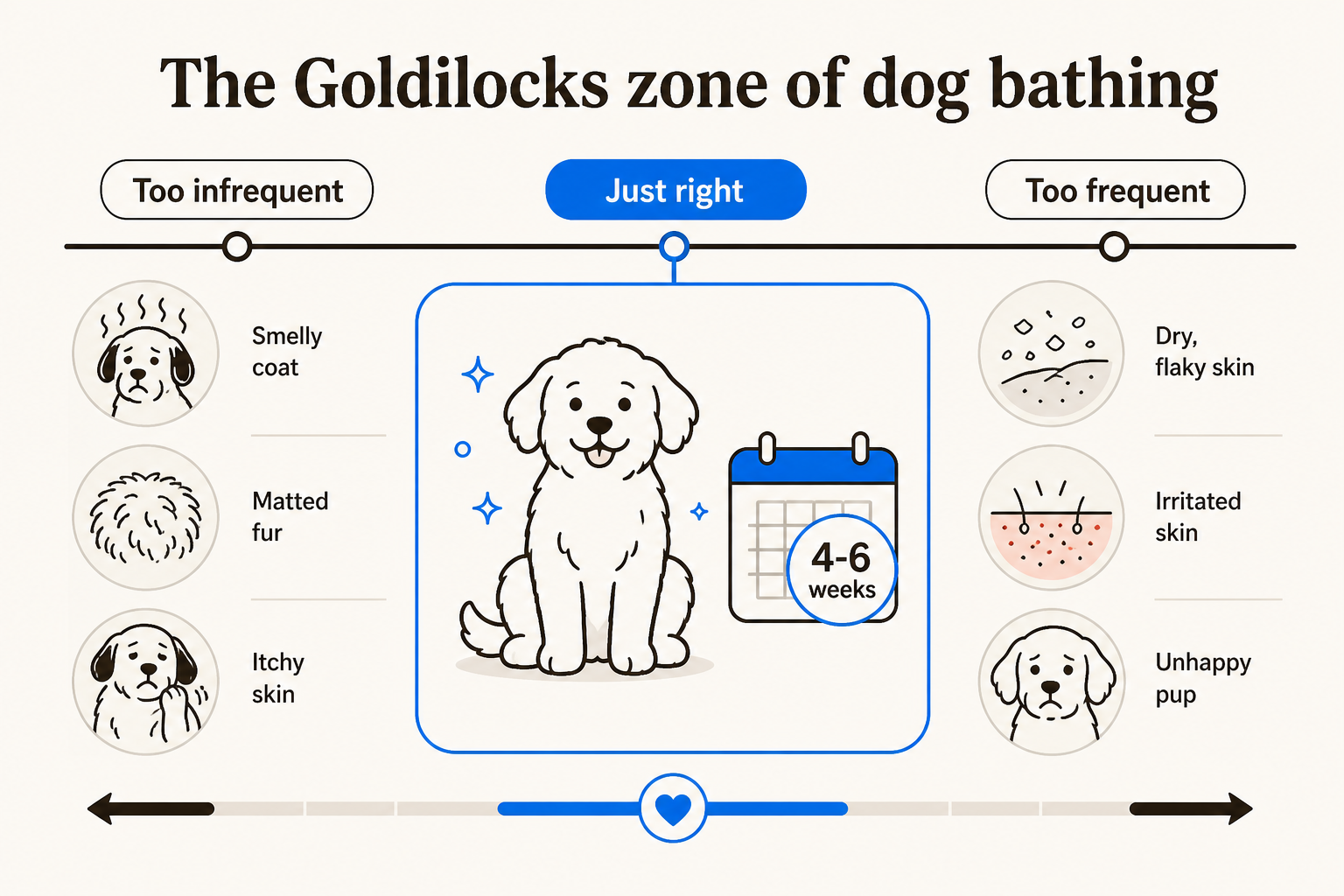
What happens when you bathe too often
Over-bathing is probably the more common mistake among well-intentioned owners who want a clean dog.
Bathing strips your dog's skin of its natural sebum layer. When you do that repeatedly, the skin can't replenish those oils fast enough. The result: dry, flaky, itchy skin. You'll notice your dog scratching more, the coat losing its sheen, and dandruff appearing in the fur. In worse cases, compromised skin becomes more vulnerable to bacterial and yeast infections - the very things frequent bathing was supposed to prevent.
"Dogs shouldn't be over washed as it dries them out and makes them itchy/flaky. So just once a month should be fine. If you have to do it more often, use a lot of conditioner."
There's also a skin microbiome argument here. Your dog's skin hosts a community of beneficial bacteria and yeast that play a role in immune defense. Frequent bathing disrupts that balance, removing the good alongside the bad.
What happens when you don't bathe enough
On the other side: not bathing often enough creates its own problems. Accumulated dirt and oils cause the coat to smell, attract more debris, and eventually become a breeding ground for bacteria. For dogs with dense or long coats, infrequent bathing allows mats to form - and mats are painful to remove once established. They trap moisture against the skin, which causes irritation and can lead to hot spots.
Parasites are also a consideration. Regular bathing doesn't replace flea and tick prevention, but it's a useful part of the overall hygiene routine - baths can help you spot and remove parasites that have made it through the fur.
Bathing frequency by coat type
Coat type is the single biggest variable in figuring out how often your dog needs a bath. Here's a breakdown that covers the main coat categories you'll encounter.
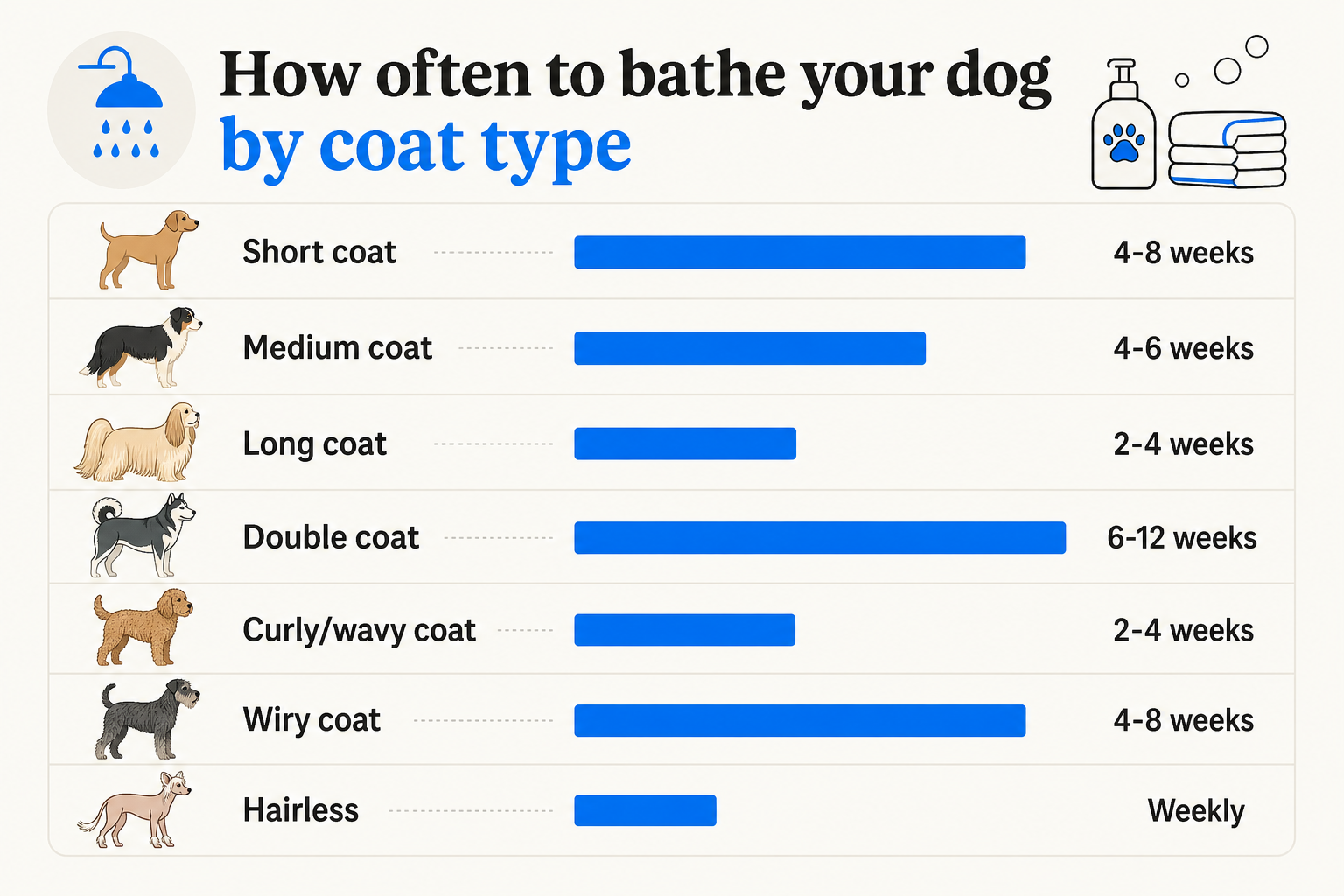
Short coat (Beagle, Boxer, Dalmatian, Weimaraner)
Every 4-8 weeks
Short-coated dogs have the most forgiving coat type. Their natural oils distribute easily across the fur, and they rarely mat. Many short-coated owners happily go 6-8 weeks between baths with no issues - just watch for smell and visible dirt as your guide.
Medium coat (Labrador Retriever, Golden Retriever, Australian Shepherd)
Every 4-6 weeks
Medium-coated dogs sit right in the standard range. These coats shed regularly and benefit from a monthly-ish bath to manage loose hair and keep the skin clean. For active Labs and Goldens that love swimming or rolling, bump closer to 4 weeks.
Long coat (Maltese, Shih Tzu, Afghan Hound, Pomeranian, Lhasa Apso)
Every 2-4 weeks
Long coats mat quickly and trap dirt at the root. More frequent bathing is genuinely necessary for these dogs - but it has to be paired with conditioning, or you'll cause the very dryness you're trying to avoid. Purina recommends regular conditioning as a non-negotiable for long-coated breeds. Daily brushing between baths is also critical - it's the only thing that keeps long coats from becoming a matted mess.
Double coat (Husky, Samoyed, German Shepherd, Alaskan Malamute)
Every 6-12 weeks
Double-coated dogs are the exception that surprises most owners. Less bathing is actually better for these breeds. Their outer guard coat is water-resistant and designed to protect the dense undercoat beneath. When you bathe a double-coated dog too frequently, you strip the water-resistant quality of that outer coat and damage its natural insulation.
For double-coated breeds, the primary grooming tool is the brush - not the shampoo bottle. During shedding season especially, daily brushing does far more for coat health than bathing.
Curly and wavy coat (Poodle, Labradoodle, Goldendoodle, Cockapoo)
Every 2-4 weeks
Curly coats are high-maintenance in a different way from long coats. They don't shed much, which sounds like a benefit - but what doesn't shed stays in the coat, trapping debris, moisture, and dead hair. Without regular bathing and professional grooming, these coats mat within days. The 2-4 week range is realistic for most curly-coated dogs, with conditioning after every bath to keep the curls manageable.
Wiry coat (Wire Fox Terrier, Schnauzer, Wire-haired Dachshund)
Every 4-8 weeks
Wiry coats are naturally somewhat water-resistant and self-maintaining. They don't need the attention that curly or long coats demand. The standard 4-8 week range works for most wiry-coated dogs, adjusted for lifestyle.
Hairless breeds (Chinese Crested, Xoloitzcuintli, American Hairless Terrier)
Weekly or as needed
Hairless dogs are the outlier. Without any fur to distribute oils or protect the skin, their skin is directly exposed to dirt, bacteria, and UV radiation. Spencer Springs Animal Hospital recommends gentle cleaning with wipes or special shampoo for hairless breeds - often weekly, with a moisturizing, gentle formula to prevent dryness. These dogs may also need sunscreen for outdoor time.
Other factors that affect how often your dog needs a bath
Coat type is the biggest variable, but it's not the only one. These factors can push your schedule up or down from the baseline.
Activity level and outdoor exposure
A Labrador that swims in a lake twice a week and rolls in mud on the regular needs baths more often than one that lives mostly indoors. A Beagle that spends all day inside needs fewer baths than its outdoor-exploring cousins. Let your dog's actual lifestyle guide you rather than a fixed calendar.
Skin conditions
Dogs with allergies, seborrhea, or chronic skin infections often have vet-prescribed bathing schedules - sometimes weekly, with specific medicated shampoos. If your dog has a diagnosed skin condition, follow your vet's guidance rather than general coat-type rules.
Age
Puppies can start being introduced to baths early to get comfortable with the process, but they don't need frequent bathing unless they're genuinely dirty. Senior dogs may become less tolerant of cold water and longer grooming sessions - consider warmer water and shorter bath times as your dog ages.
Oily skin
Some dogs naturally produce more sebum than others. Breeds like Basset Hounds and Cocker Spaniels tend toward oilier skin and coats, which means they may develop that "dog smell" faster than other breeds. These dogs often benefit from bathing every 2-4 weeks even though their coats aren't especially long or curly.
How to actually bathe your dog properly
Getting the frequency right is only half of it. Bathing technique matters just as much. A poorly executed bath can cause the same skin problems you're trying to prevent.
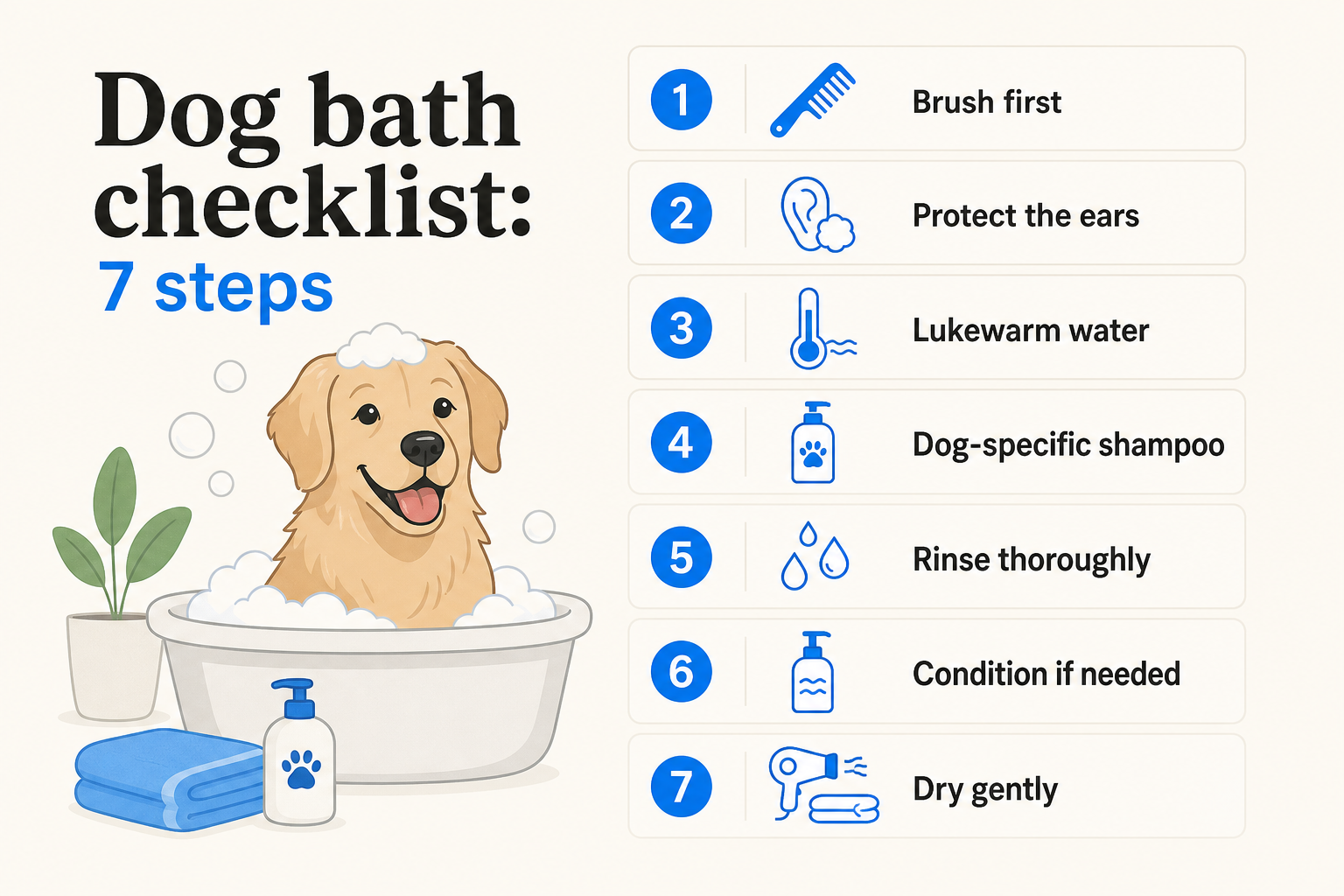
Brush before you wet
This is the step most owners skip - and it's the one that causes the most problems. Water tightens existing mats and makes them dramatically harder to remove. If you wet a tangled coat, you're going to spend twice as long on drying and detangling. Brush fully before turning on the tap.
Protect the ears
Water trapped in the ear canal is one of the leading causes of ear infections in dogs. Place a cotton ball gently in each ear before bathing. Don't force it deep - just enough to block water at the opening.
Use lukewarm water
Dogs' skin is more sensitive to temperature than ours. Lukewarm is the target - warm to the touch, never hot. Test with the inside of your wrist, the same way you'd check baby bathwater. Cold is tolerable but unpleasant; hot is actively harmful.
Always use dog-specific shampoo
Human shampoo is formulated for a skin pH of 4.5-5.5. Dog skin sits at 6.5-7.5. Using human shampoo on your dog strips the protective acid mantle and causes irritation, dryness, and sometimes rashes. This isn't an edge case - it's consistent enough that every vet and groomer will tell you the same thing.
Rinse more than you think you need to
Shampoo residue left in the coat causes itching, dandruff, and dryness - sometimes worse than not bathing at all. Rinse until the water runs completely clear with no bubbles. For long-coated and double-coated dogs, this means multiple rinse cycles.
Dry properly
Air drying works for short-coated dogs and warm climates. For long-coated and curly-coated dogs, it's not enough - damp fur mats quickly, especially at the root. If you're blow drying, use a pet dryer on a low heat setting, never a human hair dryer (too hot). Brush as you dry to prevent tangles from forming during the drying process.
Signs your dog needs a bath now - regardless of schedule
No bathing schedule survives contact with a dog who just found a dead bird. Here's when to skip the calendar and go straight to the tub:
- Noticeable smell - Beyond the normal "dog" scent, something distinctly musty or offensive
- Visible dirt, mud, or contamination - Self-explanatory
- Greasy or waxy coat - If running your hand through the fur leaves visible residue on your palm
- Visible parasites or flea dirt - Black specks in the fur that turn red when wet (flea feces) are a sign of flea infestation
- Rolling in something - Dogs have a remarkable talent for finding the worst things to roll in
If your dog's scratching dramatically increases outside of their normal pattern, that's worth investigating - but it may be more of a vet call than a bathing call, as it can signal allergies or skin conditions.
Making bath time less stressful
A lot of dogs genuinely dislike baths, especially if their early experiences were unpleasant. The good news: you can make it significantly better.
Introduce baths early with puppies, keeping early experiences positive and brief. Use treats generously - before, during, and after. Keep the environment calm: quiet, no rushing. And keep baths short, especially at first. Get in, clean efficiently, and get out. The longer it drags on, the more anxious an already-reluctant dog gets.
For dogs with severe bath anxiety, a professional groomer may actually be the easier path. Many dogs tolerate groomers better than home baths - partly because the groomer's setup is optimized for it, and partly because the novelty of a new environment seems to override the normal anxiety response.
About Pawmingos
At Pawmingos, we're building something for dog and cat people — by dog and cat people. We started with mini brick building sets shaped like your favorite dog breeds (yes, you can build a tiny Husky. Yes, it's as good as it sounds). But this blog is here for something broader: a real community space where pet owners can find honest, useful guidance about caring for the companions they love.
Because whether you're snapping bricks together or making memories with your furry companion, what drives you is the same thing — you love your pet.
That belief also shapes how we do business. With every purchase, a portion of our profits is donated to registered animal shelters and legitimate pet rescue organizations around the world, helping provide care, food, and second chances to animals still waiting for a loving home.
We'll keep creating products that bring joy, publishing content that treats you like the smart, caring owner you are, and supporting organizations that make a real difference for pets in need.
→ Visit us at pawmingos.com
👉 Explore the Pawmingos Collection — build a companion, and help a real one find home.
Frequently Asked Questions
Is it bad to bathe my dog every week?
For most dogs, yes — weekly bathing can strip natural oils and lead to dry, irritated skin over time. Exceptions include hairless breeds or dogs on a vet-prescribed medicated bathing schedule for a skin condition.
Why do Huskies and other double-coated dogs need fewer baths?
Their water-resistant outer coat protects a dense undercoat underneath. Frequent bathing strips that protection and damages the coat's natural insulation — brushing, not bathing, is the main grooming tool for these breeds.
Can I use my own shampoo on my dog?
No. Human shampoo is formulated for a different skin pH than a dog's, and using it can strip your dog's protective acid mantle, causing irritation and dryness — always use a dog-specific shampoo.
How do I know if I'm bathing my dog too often?
Watch for dry, flaky skin, increased scratching, a dull coat, or dandruff. These are signs the natural oil balance is being disrupted, and it's worth stretching out the time between baths.
What if my dog has a skin condition — does the coat-type schedule still apply?
No — dogs with allergies, seborrhea, or chronic skin infections often need a specific bathing schedule from their vet, sometimes with medicated shampoo. Always follow veterinary guidance over general coat-type recommendations in that case.
Sources: American Kennel Club (AKC), Purina, Blue Lake Veterinary, Spencer Springs Animal Hospital, r/dogs, r/germanshepherds.